

The NCAA Center
The rules that decide whether your student can play, written for a family instead of a compliance office. Every claim on this page links to the official NCAA source.
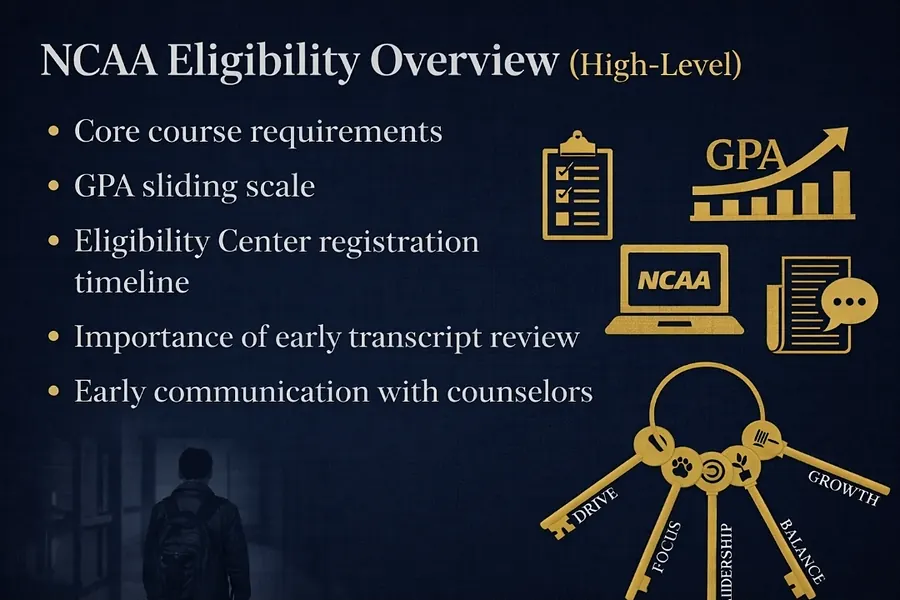
Check your coursework against the requirements
Enter your courses once, or upload a transcript, and the tracker checks them against your target division and flags a gap while there is still time to close it.
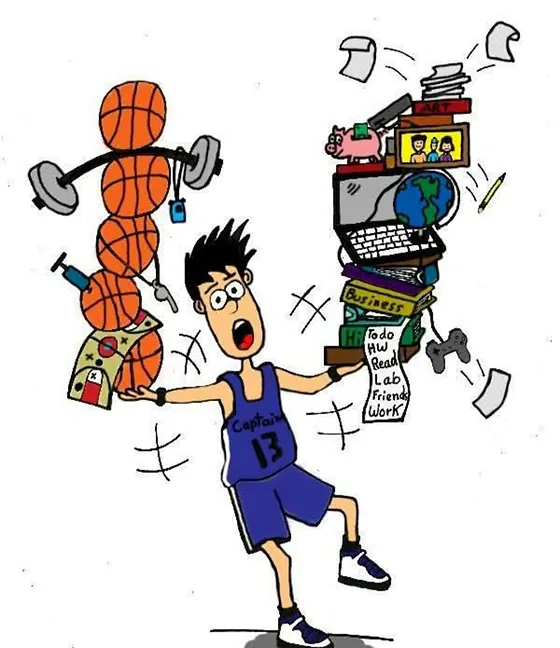
Eligibility is carried in the other arm
Every athlete trains the left side of this picture. Almost nobody trains the right side, and the right side is what the NCAA actually checks. Sixteen core courses, a sliding GPA scale, a registration deadline, and a transcript that has to hold up years after the grade was entered.
The tracker above exists because the courses that count are decided in ninth grade, and most families do not find out until eleventh.
What it actually takes
16 core courses · 2.300 core GPA
16 core courses · 2.200 core GPA
Registering with the Eligibility Center
Create your account
Open an Academic and Athletics Certification account. Sophomore year is not too early.
Work with your counselor
Confirm every course you take appears on your school's NCAA approved course list. This is the step families skip.
Send transcripts
Official transcripts go directly from your school. Keep your account current every year.
Final certification
Submit your final transcript with proof of graduation and receive your certification.
Official NCAA links
We explain it. They decide it. Always verify against the official pages.
Keys to the Journey is an independent platform and is not affiliated with or endorsed by the NCAA. Requirements change. Always confirm with the Eligibility Center and your high school counselor.
Recruiting calendar
Contact, evaluation, quiet, and dead periods decide when a college coach can call you, watch you play, or meet your family. They differ by sport and change every year, so each sport links straight to the official NCAA calendar.
Coaches may meet you and your family in person off campus, watch you play, call, and message.
Coaches may watch you play or practice and review academics, but cannot talk with you off campus.
Coaches may only talk with you in person on their own college campus. No off-campus contact or evaluations.
No in-person contact anywhere. Coaches may still call, email, and message you.
Amateurism, NIL, money, and the portal
The rules that decide amateur status changed more between 2021 and 2025 than in the fifty years before. Here is the plain version for families and the counselors who guide them. The fast moving numbers link straight to the official NCAA source so you are never working from a stale figure.
What amateurism means now
An athlete can still lose eligibility, but the old bright lines have moved. Four things still define amateur status, and two of them now have major exceptions:
- No professional salaries. An athlete still cannot sign a professional contract or take a salary from a pro team to play the sport.
- NIL is legal. Athletes cannot be paid by the school simply to play, but they can profit from their own name, image, and likeness: social media, sponsorships, autograph signings, camps, and commercials.
- Scholarships and cost of attendance. A school can cover tuition, fees, room, board, and books, plus a cost of attendance stipend for living expenses, plus Alston academic awards. None of that touches amateur status.
- Prize money is limited. In most sports an athlete cannot keep prize money beyond the actual and necessary expenses of competing. Individual sports have their own allowances, so check before accepting a check.
Schools can now pay athletes directly
After the House v. NCAA settlement, starting July 1, 2025, schools may share revenue directly with athletes, capped at roughly $20.5 million per school in the first year and rising over the next decade. This is separate from a scholarship and separate from NIL.
Third party NIL deals of $600 or more now run through a clearinghouse (NIL Go, run by Deloitte) that checks them for fair market value, and a new College Sports Commission enforces the system for the major conferences.
Transfers move freely, in windows
Academically eligible athletes can now transfer and play right away, and the one time limit is gone, as long as they enter the portal during their sport's official window and stay academically on track.
Windows differ by sport and change yearly. Football moved to a single winter window (about Jan 2 to 16, 2026); basketball uses short spring windows; many sports add a short window when a head coach leaves. Entering outside a window needs a waiver.
Five years to play four seasons
The core rule still stands: an athlete has four seasons of competition to use within a five year window once college enrollment begins. Redshirt years, injury, and now some litigation can change that.
JUCO time and the extra year
Seasons played at a junior college or other non NCAA school generally still count against Division I eligibility. After the Diego Pavia case, the NCAA granted a waiver (December 2024) giving an extra year in 2025-26 to athletes who had competed at a non NCAA school and were about to run out.
This area is still in active litigation and appeals, so the answer for a specific athlete can change. Confirm the current rule with the Eligibility Center before counting on it.
Official NCAA pages, always current
Last reviewed September 2026. Rules on money, the portal, and junior college eligibility are moving through courts and NCAA votes constantly. Use this to understand the concepts, and the official links above to confirm the current number, date, or window before an athlete or family acts on it. This is guidance, not legal or compliance advice.